How Do Surfactants and Emulsifiers Remove Grease Stains from Skin and Clothes?
Grease stains from cooking or yard work can make your skin feel slick and leave clothes looking ruined. Dish soap uses surfactants to break grease into tiny droplets, so water can wash it all away without harsh scrubbing.
This guide will walk you through the simple cleanup science:
- What surfactants and emulsifiers are, explained with a simple analogy
- My tested steps for grease on hands and on fabrics like cotton or polyester
- Why common products like Dawn or a baking soda paste work so well
- Key mistakes that can set a stain, and how to avoid them
I’ve relied on these methods for years, cleaning everything from my son Jason’s soccer jerseys to my husband Roger’s hunting gear.
The Grease Stain Problem: Why Water Alone Won’t Work
Think about rain on a freshly waxed car. The water doesn’t spread out. It beads up into little droplets and rolls right off.
Grease and oil act just like that wax on your skin or your favorite shirt. They create a slick, water-repelling barrier. Pouring water on a motor oil stain is like trying to wash your car with only a spray bottle. The grease wins every time, whether it’s on fabric from motor or cooking oil.
On your hands, this feels like a slick film that won’t rinse. On fabric, it soaks in and creates a dark, waxy ring that sets over time.
Water and oil refuse to mix, so a regular rinse just pushes the grease around without lifting it.
That’s where we need a little chemistry help. Special ingredients called surfactants and emulsifiers are the secret to breaking this standoff.
Surfactants: Your Skin’s Grease-Fighting Heroes
The name sounds fancy, but the idea is simple. “Surfactant” is short for “surface-active agent.” Its job is to break the tension between water and oil.
Imagine each surfactant molecule as a tiny tadpole. It has a head that loves water and a tail that loves oil and grease. This double-sided nature is its superpower.
Here’s how they work to save your skin in four clear steps:
- The water-loving heads latch onto the water in your sink or the rinse stream.
- The oil-loving tails burrow into and surround the grease globules on your skin.
- This action pries the grease loose, breaking it into tiny micelles (little bubbles of oil surrounded by surfactants).
- Once surrounded, the grease can be carried away by the water, leaving your hands clean.
Surfactants act like a bridge, allowing water to grab onto and wash away what it normally can’t touch.
Common, gentle surfactants you’ll find in hand soaps and dish detergents include sodium lauryl sulfate and cocamidopropyl betaine. They are powerful but designed to be kind to skin.
This is why a good dish soap is my first line of defense for skin. Its entire formula is built around surfactants that target cooking oils, making it perfect for any oily mess.
What Helped Me: The Stain Wiki Editor’s Field Note
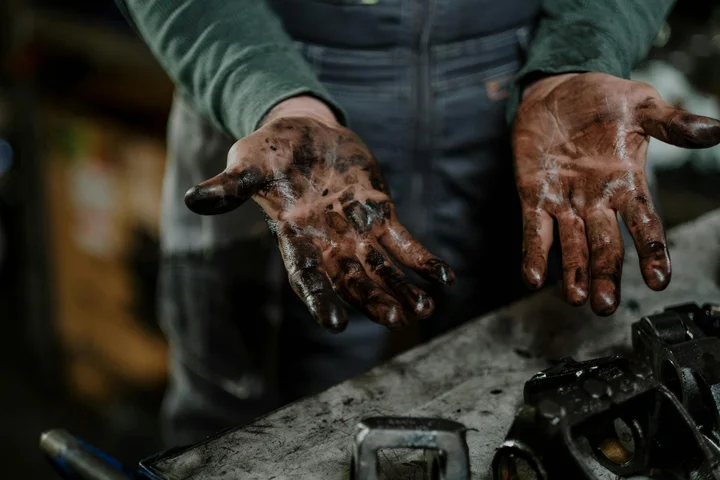
My son Jason loves helping his dad, Roger, with yard work. This usually ends with both of them coming inside, hands covered in a mix of dirt and lawnmower grease.
Water and a regular bar soap did nothing. The grease just smeared.
I keep a bottle of the original blue Dawn by the sink for exactly this reason. A small dab, some warm water, and the surfactants in that Dawn cut through the grease without any harsh scrubbing. Their hands are clean in 30 seconds, no slick residue left behind.
It’s a perfect, daily example of surfactants in action. They turn an impossible cleaning job into a simple one.
Emulsifiers: The Fabric’s Secret Weapon Against Grease
Think about that favorite gravy or creamy salad dressing. You shake it, and for a minute, the oil and water blend into a smooth, uniform mixture. That’s the work of an emulsifier in your kitchen.
In your laundry room, emulsifiers do the exact same heroic job on grease stains, similar to the products you use to remove grease stains from clothes. They are the agents that force oil and water to mix into a stable, rinse-able solution.
Here’s how it works on a greasy t-shirt. When grease hits fabric, it coats the fibers in a slick, water-repelling film. Plain water just beads up and rolls right off.
An emulsifier molecule has a unique structure. One end is attracted to grease (hydrophobic), and the other end is attracted to water (hydrophilic).
When you apply a cleaner with emulsifiers, those molecules swarm the grease spot. The grease-loving ends latch onto the oil molecules.
The water-loving ends face outward, forming a protective shell around each tiny droplet of grease. This action breaks the grease into microscopic droplets and suspends them safely in the wash water, creating what’s called an emulsion.
This is the critical step that prevents a bigger mess. Without emulsifiers, agitated grease in the wash water would just splash back onto your clean clothes as the water drains.
My son Jason’s soccer jerseys are proof. After a game, they’re stained with grass stains from sports pants fabrics. The emulsifiers in our detergent surround that grime and keep it floating away in the water until it goes down the drain.
By suspending the grease, emulsifiers stop it from redepositing on other clothes during the wash cycle, which is why your whole load doesn’t come out spotty. This principle also helps with grease stains on pants or jeans. For stubborn spots, pre-treat before washing.
The interaction is easier to picture with food. A basic vinaigrette of oil and vinegar will always separate because there’s nothing to bind them.
But add mustard (a natural emulsifier) and whisk. It creates a creamy, stable sauce that stays mixed. Your laundry detergent works just like that mustard.
It takes the separated “ingredients”-the grease on your clothes and the water in your machine-and blends them into a mixture that rinses clean away.
Surfactants vs. Emulsifiers: What’s the Difference in Your Cleaner?
People use these terms interchangeably, and for good reason. They are close cousins in the cleaning world and almost always work together. But they have slightly different specialties.
I think of it like a two-person team cleaning a very dirty, greasy pan.
The key difference is this: surfactants are primarily the “lifters,” and emulsifiers are primarily the “holders.”
A surfactant (surface-active agent) is the first responder. Its job is to reduce the surface tension of water, letting it soak into fabric instead of beading up.
It then gets its “fingers” under the stain, loosening it from the fibers. My Aunt Jessica’s red wine stain on the tablecloth needs this initial attack to break the stain’s grip.
An emulsifier is the support crew that arrives right after. Once the surfactant has broken the grease free, the emulsifier encapsulates it.
It creates that stable suspension I talked about, holding the grease in tiny droplets within the water so it can’t reattach to anything.
In most household cleaners, a single ingredient often performs both roles. The molecules are designed to lift and suspend. That’s why in most cleaning products you buy, they work as an inseparable team and the terms are often used interchangeably on labels.
This combination is non-negotiable for laundry. Think about Roger’s work jeans after he’s been tinkering with the lawnmower.
They have ground-in grass stains and motor oil. A surfactant-rich detergent wets the fibers and lifts the grime. The emulsifiers immediately trap it.
During the spin cycle, that trapped grease is thrown out with the water instead of being slammed back into the denim. This same mechanism also helps remove grease stains from polyester and nylon clothing, which can be stubborn without the right approach. Their combination in laundry detergents is what allows you to tackle greasy stains on apparel effectively in a single wash cycle.
One gets the stain up, and the other makes sure it stays gone for good.
Putting Science to Work: Step-by-Step Grease Removal Guides
When grease hits, your first move decides everything.
For any fresh stain, on any surface, follow this immediate first-aid.
- Grab a clean cloth or paper towel.
- Gently blot and press to soak up as much oil as you can.
- Never, ever rub. Rubbing pushes the grease deeper into fibers and makes a small spot a huge one.
For Skin and Hands
You just changed the car oil. Or maybe you helped Roger with the grill.
Your hands feel slick and grimy. Regular soap often just slides over it.
- Reach for a surfactant-rich soap. I always use a clear dish liquid.
- Apply it directly to dry, greasy hands. Don’t wet them first.
- Work it into a thick, rich lather. You’ll feel the slickness start to break up.
- Rinse thoroughly under warm (not scalding) water.
- Repeat if you still feel any oily residue.
For stubborn mechanic’s grime under fingernails, make a gentle paste.
Mix a teaspoon of baking soda with a few drops of dish soap.
Gently scrub your nails and cuticles with the paste, then rinse. The mild abrasion helps lift what surfactants alone can’t.
For Clothing, Upholstery, and Carpet
Jessica’s spaghetti night or Peeta’s slobber on the couch cushion. Here’s the plan.
- After blotting, apply a pre-treatment. Use a heavy-duty liquid laundry detergent straight from the bottle.
- Dab it on, completely covering the stain. Let it sit for at least 15 minutes. This gives the emulsifiers time to work.
- Wash the item in the hottest water the fabric care label allows. Heat helps keep the oil liquefied for removal.
For a set-in stain on a couch arm or carpet, you need some gentle agitation.
Use a soft-bristled toothbrush you don’t mind ruining.
Brush in tiny circles starting from the outer edge of the stain and working inward. This contains the mess instead of spreading it. Avoid common stain-removal mistakes that can set stains or damage fabric.
Blot frequently with a damp cloth to lift the suspended grease away.
For Hard Surfaces: Driveways and Car Interiors
Roger’s truck drips oil. A pizza box leaves a grease spot on the plastic car console.
These jobs need a dedicated degreaser, which is packed with powerful surfactants.
- Apply the degreaser according to its label directions.
- Let it dwell on the stain for 5-10 minutes. You’ll see the grease start to loosen and break apart.
- Scrub firmly with a stiff brush for concrete, or a softer brush for car plastic.
- Rinse the area thoroughly with a hose or plenty of water. Any leftover degreaser can attract more dirt.
Always test your degreaser in a small, hidden spot first on colored concrete or your car’s interior plastic. Some strong formulas can fade colors or damage finishes.
Critical Warnings and Pro-Tips from the Field
Trust me, I’ve learned some of these the hard way.
The single most important rule in all of cleaning is this: always do a spot test in a hidden area first.
An inside seam, the back of a cushion, a corner of the driveway. It takes 60 seconds and saves so much regret.
Material Red Flags
Surfactants are powerful. They can damage delicate materials.
If your grease stain is on any of these, stop. Do not try home remedies.
- Dry-clean only silks and wools
- Leather or suede (jackets, shoes, furniture)
- Antique or heirloom fabrics
- Some specialty performance fabrics
Take these items to a professional cleaner immediately and point out the stain.
There are also actions that can make a grease stain permanent.
- Never pour undiluted bleach or ammonia directly on a grease stain. It can set it and ruin the fabric.
- Never use hot water on a grease stain mixed with something like egg or milk. Heat will cook the protein, gluing the grease in place.
What Helped Me: A Pro-Tip from My Mom, Martha
My mom, Martha, in North Texas, has the best, simplest hacks.
For a fresh grease spot from frying bacon on a plain cotton T-shirt, she taught me this decades ago.
“Just rub a dab of clear dish soap right into the spot, let it sit for ten minutes, then toss it in the wash. The emulsifiers in the soap grab the oil before the washer even starts.”
I’ve used this on work shirts, Jason’s soccer jerseys, and my own aprons. It works like a charm almost every time.
FAQ About Using Surfactants and Emulsifiers on Grease Stains
1. What’s a quick fix for greasy hands if I don’t have dish soap handy?
Use a paste of baking soda and a few drops of water to scrub gently; its mild abrasion helps lift the oil. This technique is great for removing cooking oil stains from clothes. Rinse thoroughly, as any leftover paste can be drying to your skin. Afterward, launder as usual to finish the stain removal.
2. How long should I let the detergent “pre-treat” a grease stain on my shirt before washing?
Let it sit for at least 15 minutes to give the emulsifiers time to fully surround the grease droplets. For older, set-in stains, allowing it to dwell for up to an hour can be more effective.
3. Can I use the dish soap method on any fabric, like silk or wool?
No, never use this method on dry-clean-only silks, wools, leather, or suede. The surfactants can damage these delicate fibers-take such items to a professional cleaner immediately.
4. I washed a grease stain but it’s still visible. What’s my next step?
Do not put it in the dryer, as heat will set the stain permanently. Re-treat the area with detergent, let it sit, and wash again using the hottest water the fabric can safely tolerate.
5. What’s a simple way to prevent grease stains on clothes while cooking or working?
Wear a dedicated apron or an old cotton shirt to create a barrier between the grease and your good clothes. Treating the apron with a stain repellent spray can add an extra layer of protection and make removing oil stains from fabric easier if they do occur.
Your Action Plan for Grease Stains
Always attack a grease stain with a surfactant-based cleaner-like common dish soap-before it sets. This simple step lets the emulsifiers surround and lift the oil, so it rinses cleanly away from skin or fabric. I use this method every time, whether it’s on Jason’s soccer jersey or my own hands after fixing the lawnmower with Roger. That same approach works just as well for removing grease from hands after a DIY project. A quick lather with dish soap lifts the oil from skin, too.
For more trustworthy guides that blend science with real-life testing, stay with us here at Stain Wiki.
Written by Suzanne Rosi Beringer. Suzanne is an accomplished chemist, laundry expert and proud mom. She knows the science and chemistry of stains and has personally deal with all kinds of stains such as oil, grease, food and others. She brings her chemistry knowledge and degree expertise to explain and decode the science of stain removal, along with her decades long experience of stain removal. She has tried almost everything and is an expert on professional and DIY stain removal from clothes, fabric, carpet, leather and any other items dearest to you.